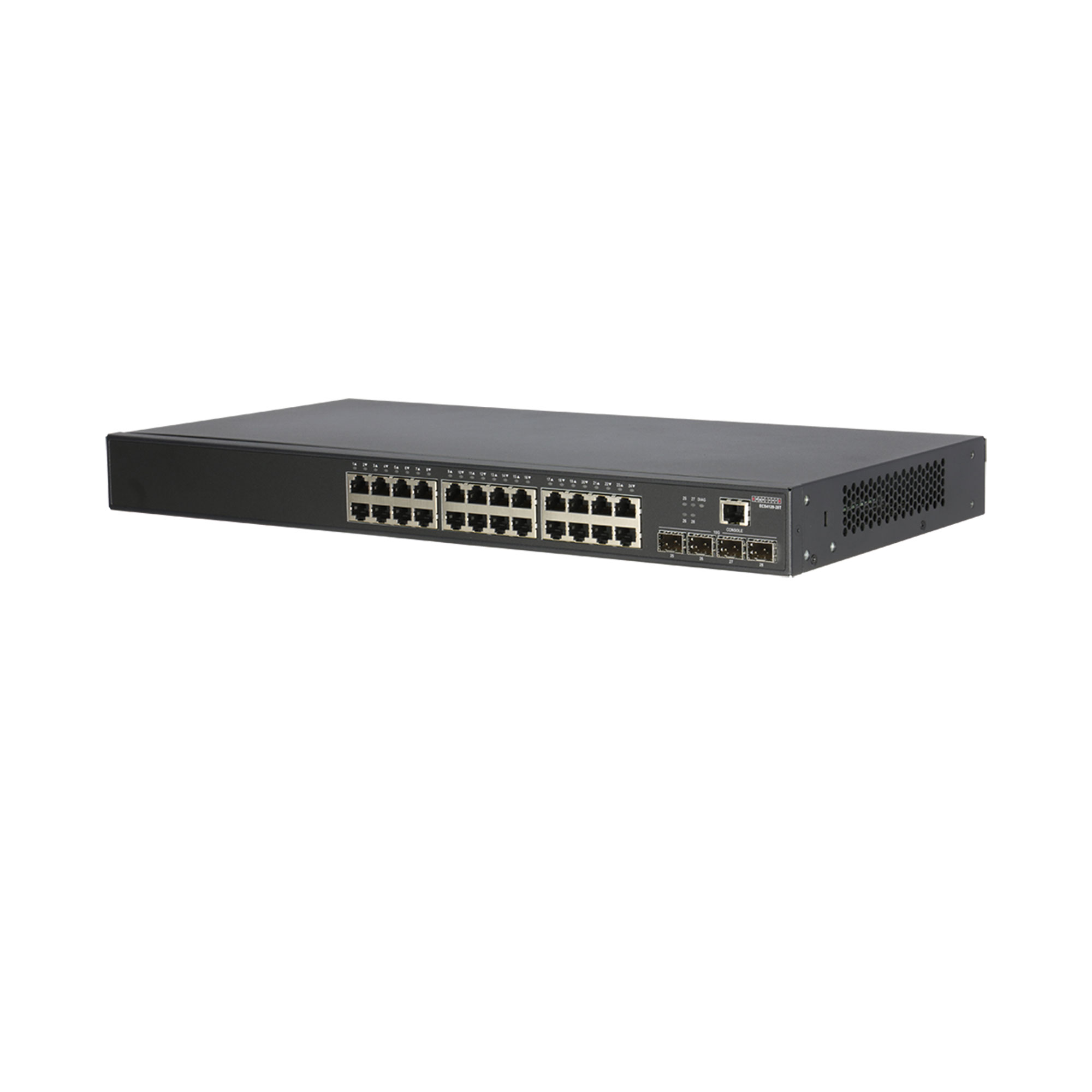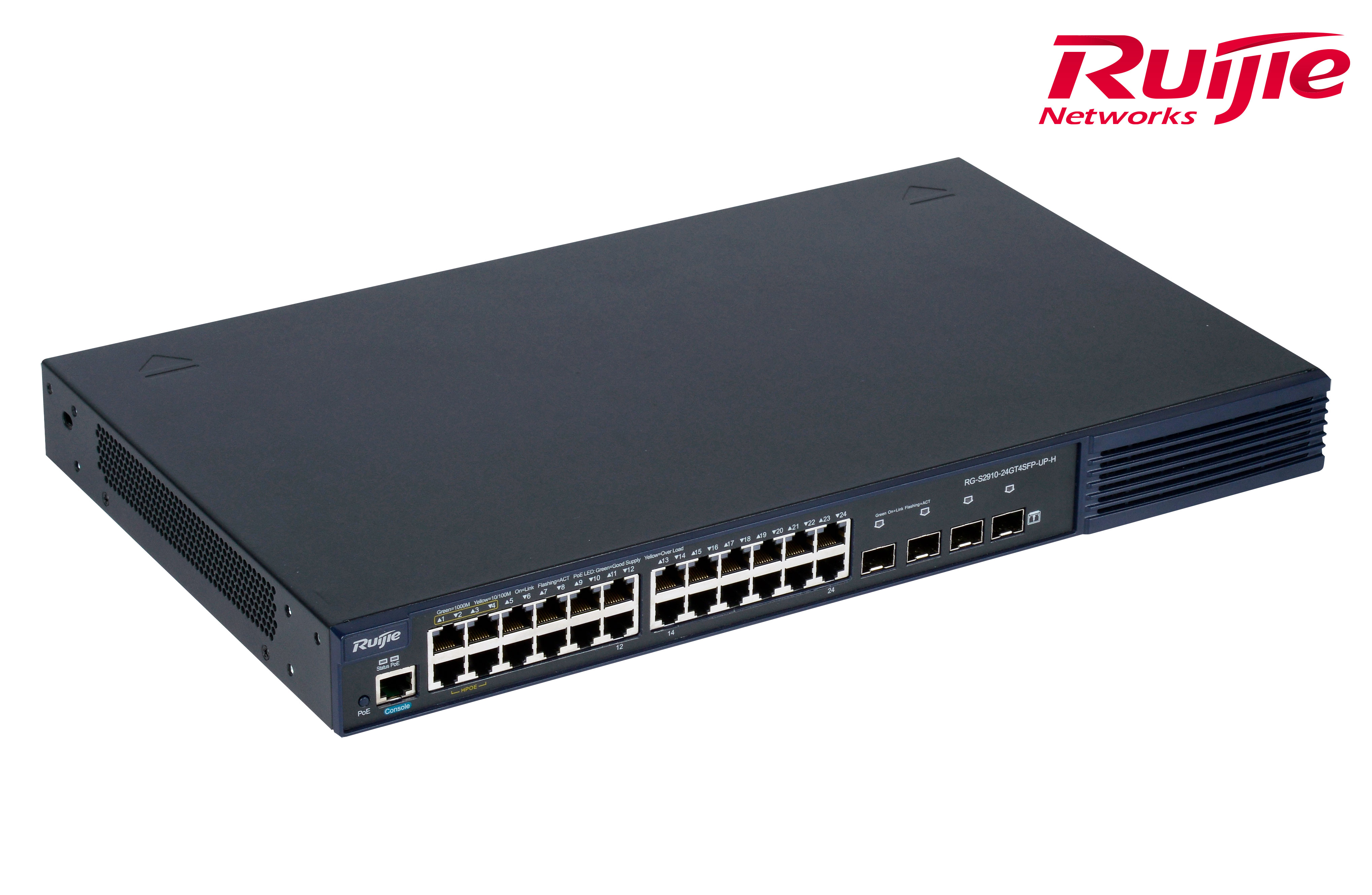
Stock Code: RG-S2910-24GT4SFP-UP-H



| General Information | |
|---|---|
| Product Type | Managed Layer 2+ PoE Switch |
| Application | IP cameras, wireless access points and network access points |
| Port Configuration | |
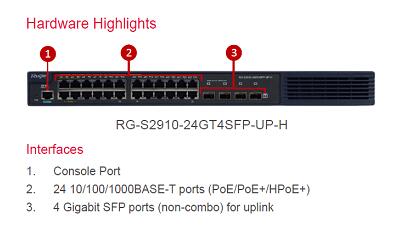
| RJ45 Ports | 24 × 10/100/1000 Mbps Gigabit auto-negotiation electrical ports (PoE/PoE+) |
| SFP Ports | 4 × Gigabit (1GE) SFP uplink ports (non-combo) |
| PoE Features | |
| PoE Standard | IEEE 802.3af / IEEE 802.3at / IEEE 802.3bt |
| Total PoE Power | 370 W |
| Max. Power per Port | 60 W (HPoE) |
| Switch Capacity | |
| Switching Capacity | 56 Gbps |
| Packet Forwarding Rate | 42 Mpps |
| MAC Address Table | 16K |
| Network Features | |
| VLAN | 4000 VLANs |
| Routing | IPv4/IPv6 static route, RIP, RIPng, OSPFv2, OSPFv3, routing policy |
| STP Support | STP / RSTP / MSTP (IEEE 802.1d / 802.1w / 802.1s) |
| Management | |
| Management Interfaces | Web, CLI (Telnet/console), SNMP, SSH, RMON, Syslog, NTP/SNTP, FTP, TFTP, sFlow |
| Cloud Management | Ruijie Cloud |
| Security | |
| Security Features | ACL, 802.1X, DHCP Snooping |
| Physical Specifications | |
| Mounting | 19" rack mounting |
| Dimensions (W × D × H) | 440 × 260 × 44 mm (17.32 in. × 10.24 in. × 1.73 in.) |
| Operating Temperature | 0°C ~ 50°C (32°F ~ 122°F) |
New Option for High Power IP Devices
There used to be only two options available for remote power supply scenarios, namely PoE and PoE+ standards. The PoE standard would fail to meet the needs if more than 30W power is required. Instead, electrical wiring or even high power has to be deployed. Such implementation gives an enormous burden to total investment cost, completion schedule, post-sale maintenance, as well as installation safety. Based on IEEE 802.3bt, Ruijie delivers an innovation approach leveraging the HPoE power supply technology, maximizing user experience from the fundamental level.
Wide Selection of Power Supply Standards
The HPoE switch supports IEEE 802.3af, IEEE 802.3at and IEEE 802.3bt and is also backward compatible with earlier standards, offering up to 90W output per port and 370W per device. The front 1-4 ports enable high power PoE application.
Outstanding Power Supply Stability
Getting power through electrical wiring come with the following disadvantages: Firstly, the power supply devices and cables are usually proprietary. In other words, there is a lack of standardization among devices and cables from different vendors. Secondly, the cable loss and voltage drop require manual adjustment to fulfill the needs of various endpoints. The average error is more than 10%, making device susceptible to failure and jeopardizing deployment efficiency. Last but not least, getting power from electrical wiring means centralized power supply. However, most endpoints do not share the same power requirement and the average utilization rate is less than 70%. There is also a high risk that if one device is lost and all can be lost. Generally speaking, more than 30% of system failure events are caused by power supply annually.
The HPoE power supply solution takes a different approach. Instead of simply lowering the failure rate, the solution precisely locates the crux of the problem and hence eliminates it. The solution supports the leading IEEE802.3bt to enable sustainable development. Also, the cable loss and voltage drop adjustment are carried out digitally with an average error rate <5%. The feature hence enables a stable voltage condition and speeds up deployment efficiency. The HPoE solution implements an independent power supply mode. Each HPoE port carries one endpoint only and automatically allocates the power required. Any failure event of one device is isolated from each other. The power utilization rate reaches up to 100%. In general, the solution usually maintains a power-failure-free period for more than 5 years.
Highly Customizable for Various Needs
The HPoE device supports regular power on/off settings for all HPoE, PoE+ and PoE ports. It can control to switch on/off all endpoints connected. Based on the actual deployment needs, users can set to suspend a certain devices from operation within a designated period. The feature ensures key services to operate in a stable manner during peak traffic periods. By putting some endpoints to rest within an idle period, energy consumption is greatly reduced and endpoint life cycle is therefore extended significantly.
The device also enables consistent power supply by hot startup. During restart or upgrade, stable and continuous power supply is guaranteed to maintain the operation of key services.
Two power supply modes, energy-saving and auto supply, are available for on-demand application.
The device offers an auto PoE switching button, enabling users to change the LED indicator display mode of the port with just one click. PoE output status of all the ports is available at a glance.
Best-in-class Management Easiness
Leveraging Existing Network Cabling
The traditional electrical wiring involves a range of tedious procedures on the wall or the floor. Such include groove opening, pipe laying, voltage and current testing and so on. Everything from the groove diameter and depth to spacing, PVC tube dimensions to curve radius of laying tube, as well as electromagnetic interference among various cables must be taken into consideration. With just one mistake in any aspect, the overall wiring outcome will be largely at stake and the end user experience will be undermined. Ruijie offers you a painless solution and what you need is just network cable. For new buildings, only network cabling needs to be taken care of. For expansion with weak power devices, users can leverage the existing network cabling. No more wall-breaking work incidental to electrical wiring is required.
Painless Management
Since there are numerous subnet systems of low powered devices, it is very difficult to centrally manage all of them. Also, each subsystem demands in-depth technological knowledge, which pose challenges to administrators. This would slow down the troubleshooting process. Also, point location, maintenance and failure logs are all recorded manually, making related data keeping and enquiry much more difficult.
To provide an end-to-end solution for the above, Ruijie has launched an intelligent operation platform RIIL IPDM (IP Devices Management). The software achieves centralized and visible management on IP devices. The RIIL IPDM enables administrators to discover failure point immediately for upgraded work efficiency.
The HPoE switch also supports SNMP V1/V2/V3, RMON, Syslog, SFLOW and USB for routine diagnosis and maintenance. A diversity of management modes are available and such include CLI (command line interface), web gateway, Telnet, CWMP(TR069) zero configuration for easy maintenance.
Cost and Time-efficient Deployment
Time and Cost Savings
Electrical wiring involves a series of construction work and tests, which means requiring more human resources, longer implementation period and higher deployment costs. The wiring work sometimes costs even more than that of device purchase. The HPoE deployment does not only help users to save costs on wiring and labor, the service also turns up faster than any traditional solutions.
Exceptional Energy Efficiency
The HPoE device supports energy-saving and auto supply PoE modes for various deployment needs.
The device features auto-power-down, a function enabling the system to automatically power off any interface which has been down for a certain period of time. The switch is also IEEE802.3az (EEE) compliant. A port will enter the energy-saving mode if it has been idle for an extensive period. When there is an incoming/outgoing packet, the port will resume service as informed by listening stream.
The devices are compliant with the RoHS standard, and SJ/T 11363/11364/11365.
Safety and Security Features
Power Supply Safety
Getting power over electrical wiring features low loss and high efficiency. However, the high power, voltage and current are potential hazards to technicians during installation or maintenance stages. The HPoE technology carries power on cables (twisted pair) with low voltage, which offers improved safety.
Device Safety
High power is also a threat to devices. With thunderstorm or electromagnetic interference, devices are vulnerable under high current. The HPoE device, on the other hand, implements various protection mechanisms. When an IP camera breaks down or short circuit is detected, the device will remain intact under the overcurrent protection.
The device also supports lightning protection up to 8KV, ensuring stable operation under severe weather conditions.
Network Security
The HPoE switch also inherits security features from conventional switches:
Superior Network Stability
Virtualization for Simplified Maintenance
VSU (Virtual Switch Unit) virtualizes multiple physical devices into one logical appliance. The VSU can be managed using one IP address, Telnet process and CLI, automatic version checking and configuration, etc. The VSU brings along advanced work efficiency and user experience while users only need to manage one single device.
Standard Protocol for Seamless Integration
The ERPS (G.8032) enables loop elimination and link recovery on the master device. Non-master devices directly report link status to the master without passing through others. Hence, the processing time for loop elimination and link recovery are faster than STP. Under ideal conditions, the link recovery of ERPS can be completed within millisecond.
SDN Advancement
The HPoE device fully supports OpenFlow1.3. In collaboration with Ruijie’s proprietary SDN controller, large-scale L2 framework and smooth transition to SDN network can be easily achieved, largely simplifying network management and reducing maintenance costs.